
Why Choose SLSA For Cosmetic Formulations?
What Is SLSA? Chemical Basics & MechanismSLSA is the sodium salt of lauryl sulfoacetic acid, with the molecular formula C₁₄H₂₇NaO₅S and a molar mass of 330.41 g/mol. Its structure consists of ahydrophobic C12 lauryl tail (binds oils and dirt) and a hydrophilic sulfoacetate head (ensures water solubility and foam formation). Unlike Sodium Lauryl Sulfate (SLS), SLSA has a larger molecular size and an ester-linked sulfoacetate group instead of a sulfate ester bond. This structural difference is the foundation of its mildness. |  |
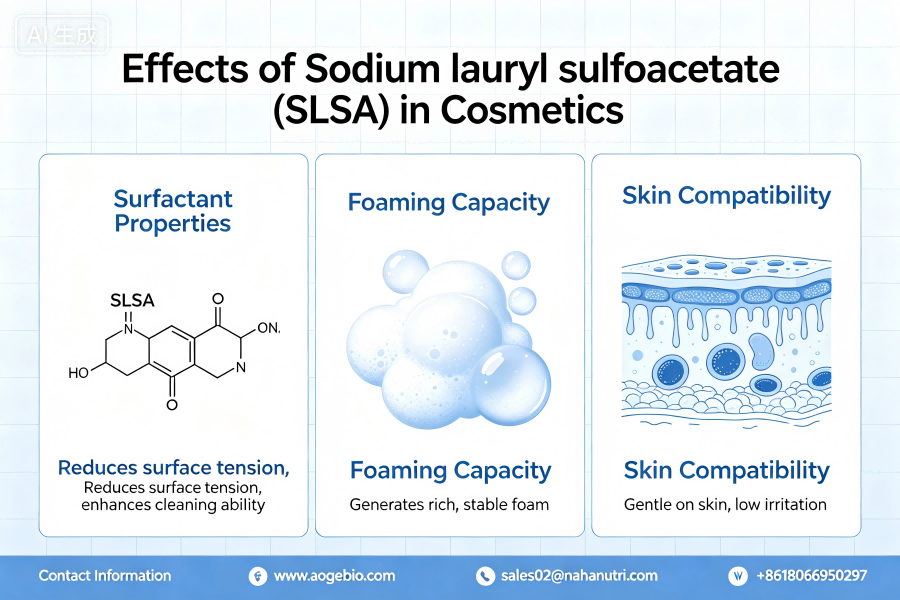
As a surfactant, SLSA works by lowering water surface tension, enabling it to emulsify oils, suspend impurities, and create stable foam. Its key functional properties include:
High foaming power: Produces dense, creamy, long-lasting lather (comparable to SLS).
Excellent wetting & rinsing: Spreads evenly on skin/hair and rinses off completely, leaving no residue.
Hard water stability: Maintains performance in water with high mineral content (pH 5.0–8.5).
Biodegradability: Aerobically biodegradable, meeting eco-friendly formulation standards.
Core Advantages of SLSA in Cosmetics
- Superior Mildness & Low irritation
The most significant advantage of SLSAover SLS/SLES is itsreduced skin penetration. At ~330 g/mol, SLSA’s large molecules cannot easily pass through the stratum corneum (skin’s outer barrier), minimizing disruption to lipid layers and tight junctions. A 2021 double-blind clinical study (48 participants with mild-to-moderate rosacea) compared 1.0% SLS and 1.3% SLSA cleansers over 8 weeks:
SLS group: 27% drop in skin hydration, 34% increase in TEWL (transepidermal water loss), and 62% reported flushing/stinging.
SLSA group: Maintained baseline hydration, 5% TEWL increase, and only 9% reported irritation.
The Cosmetic Ingredient Review (CIR) Expert Panel confirms SLSA is safe for cosmetics, with recommended concentrations: ≤10.2% in rinse-off products (shampoos, body washes) and ≤2% in leave-on products. The EWG Skin Deep database rates SLSA as low concern (Score: 1) for cancer, allergies, and reproductive toxicity.
- Rich, Stable Foam for Sensory Appeal
Consumers associate creamy foam with effective cleansing and luxury. SLSA generates a velvety, dense lather that is more stable than many mild surfactants (e.g., cocamidopropyl betaine). Its foam remains consistent across pH 5–8 and hard water, making it ideal for high-end cleansing products.
- Versatile Formulation Compatibility
SLSA is a free-flowing white powder/granule, soluble in hot or cold water, and compatible with amphoteric, nonionic, and anionic co-surfactants. It works well with:
Betaines (e.g., Coco-Betaine) to boost mildness.
Glycosides (e.g., Decyl Glucoside) for sulfate-free blends.
Humectants (glycerin, hyaluronic acid) to enhance hydration.
- Sulfate-Free & Sustainable
SLSA is 100% sulfate-free (no SLS/SLES), aligning with clean beauty trends. It is derived from renewable plant oils (coconut/palm kernel) and is aerobically biodegradable, reducing environmental impact.
Key Applications in Cosmetic Formulations
- Facial Cleansers & Syndet Bars
Ideal for sensitive, dry, or acne-prone skin. SLSA cleanses without stripping natural oils, maintaining the skin barrier. Recommended concentration: 2–5%.
- Shampoos & Scalp Treatments
Perfect for dry scalp, dandruff, or color-treated hair. It removes sebum and product buildup without irritating the scalp or fading hair dye. Recommended concentration: 3–8%.
- Body Washes & Bubble Baths
Creates luxurious foam for daily use. Gentle enough for children and sensitive skin. Recommended concentration: 5–10%.
- Solid Cleansing Products (Shampoo Bars, Bath Bombs)
As a powder surfactant, SLSA is essential for solid formats, providing foam and structure without liquid binders.
- Oral Care (Toothpaste, Mouthwash)
Used as a mild foaming agent in sulfate-free toothpastes, reducing oral irritation and canker sore risk.
Frequently Asked Questions (FAQ)
Q1: Is SLSA the same as SLS?
No. SLSA (Sodium Lauryl Sulfoacetate) and SLS (Sodium Lauryl Sulfate) are chemically distinct. SLSA has a larger molecular size, ester linkage, and sulfoacetate group—making it far milder. SLS is small, penetrates skin easily, and causes irritation at low concentrations (0.5%).
Q2: Can SLSA cause allergies?
Rare. Patch testing shows SLSA has low allergenicity (<1% severe reactions). Most adverse effects are mild redness from high-concentration (≥30%) misuse.
Q3: Is SLSA safe for babies and sensitive skin?
Yes. CIR and clinical data confirm SLSA is safe for infant baths, baby shampoos, and sensitive skin formulations when used at ≤5%. It avoids the dryness and irritation of SLS-based products.
Q4: Does SLSA strip hair color or natural oils?
No. Its large molecules only clean the hair surface, not penetrating the cuticle or stripping color pigments. It preserves scalp sebum, reducing dryness and frizz.
Q5: How stable is SLSA in formulations?
Highly stable. SLSA resists hydrolysis in pH 5.0–8.5 and tolerates temperatures up to 80°C. It is compatible with most preservatives and actives.
Conclusion
Sodium Lauryl Sulfoacetate (SLSA) is a game-changing surfactant for modern cosmetics. It combines SLS-level foam and cleansing power with exceptional mildness, addressing consumer pain points like dryness, irritation, and scalp sensitivity. Supported by rigorous clinical trials and CIR safety assessments, SLSA is ideal for sulfate-free, clean beauty, and sensitive skin formulations. Whether in facial cleansers, shampoos, or solid bars, SLSA delivers performance, safety, and sustainability—making it the preferred choice for formulators prioritizing skin health and consumer satisfaction.
Research References & Safety Data
*Cosmetic Ingredient Review (CIR) Expert Panel. (2022). Final Report on the Safety Assessment of Sodium Lauryl Sulfoacetate. International Journal of Toxicology, 41(Suppl 1), 1–15. Confirms safety at ≤10.2% rinse-off and ≤2% leave-on.
*Torres, L. et al. (2021). Surfactant Barrier Disruption in Rosacea: A Randomized Controlled Trial. Journal of Cosmetic Dermatology, 20(8), 2567–2575. Double-blind study proving SLSA’s mildness vs. SLS.
*EWG Skin Deep Database. (2026). Sodium Lauryl Sulfoacetate. Environmental Working Group. Safety score: 1 (low concern).
*American College of Toxicology. (2020). Irritation Potential of Anionic Surfactants. Toxicology Letters, 329, 112–120. SLS causes irritation at 0.5%; SLSA non-irritating at ≤10%.
Name: Yuki
E-mail: sales02@nahanutri.com
WhatsApp:+8618066950297